
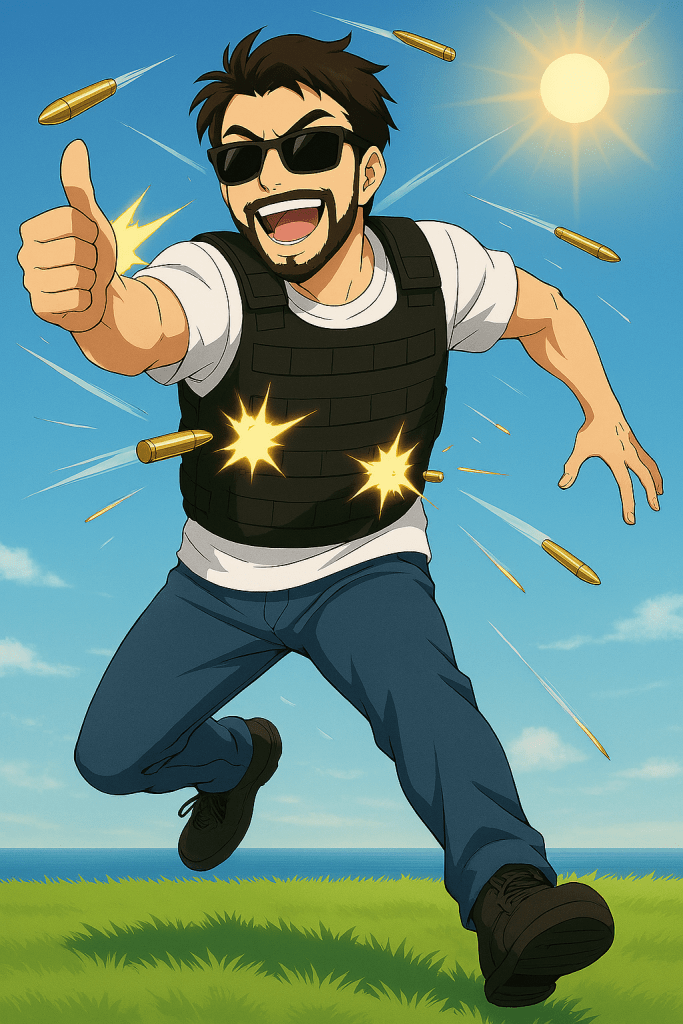
Sobriety can be like a bullet proof vest
The thing that kept me (at least superficially wit the dubious help of the “bad advisor” (what I framed the voice in my head from my alcohol addiction after a tipp from a coach)) from working on sobriety was the common belief in my head “you can’t get sober by yourself”.
Of course, your addiction (the bad advisor, or whatever other voice in your head) will always force thoughts upon you that will keep you from taking steps to quitting, because it is inherent to the power of an addiction to manipulate your brain to stay focused on what your reward system yearns for: Quick dopamine kicks through alcohol.
But then, you might muster all your willpower to take a break from drinking and forcing yourself into a period of sobriety, or you might be forced to take a break because you have to go into a withdrawal therapy in a clinic.
In the end, your addiction will find ways to make you drink again, or you might want to fight being sober with all the willpower you can muster. At least that was MY experience.
I will not discuss the different ways of getting sober here. I only want to describe what worked for me:
I was stuck in circle of self blaming, drinking rules and self fraud about my drinking habits (“I will stop tomorrow”, “I will drink only on weekends”, “I will drink only beer”, you get the gist). I thought of going to the AA. I was afraid of the weekly meetings and a sect-like organization (which is, of course, bullish*t, but that was like my thoughts went). I thought of going to the doctor (but then I would have had to admit I have a problem, which I didn’t want to admit). Furthermore, I was afraid my family might find out and my wife would leave me. Then I was afraid of stigmatization.
So, I tortured myself over 5 long years with frauding myself and finding excuses and faking and drinking secretly. Until it made click that one day. I figured I needed a plan and after starting sports I made the following plan:
- Try an app
- Take a break in vacation and talk to my wife to have someone to be accountable to.
- If that wouldn’t have worked I would have bitten my lip and opened up to a doctor
I wasn’t quite sure if I would have appleid #3, but I was determined enough to try this way and found the Reframe App (!Disclaimer!: I am not paid by them and this is no advertisement!). I don’t want to discuss this app here, I just want to say that it worked for me as a tool to find new thoughts about drinking and having a tool to track down my alcohol. Interestingly, that was motivator enough to at least cut back my drinking. A couple of events that followed led to the conclusion that I wanted to quit altogether. I think it had to do with the fact that I found a lot of online programs to try to reduce and then quit alcohol consumption.
And that is, where my work experience and my professional education came into play: I show parents and kids how to enhance self efficacy and how to tap the reward system in kids (Having worked as a teacher for kids with special needs in emotional and social issues, ADHD, Autism and the like, I knew that this was a game changer).
I knew that my work as a teacher and social worker had always been a kind of therapying myself (I didn’t know back then that alcohol had a significant impact on my feeling of self worth (drinking as part of masculinity, blah blah, cf. one of my earlier posts). But, as a teacher and social worker that gets a direct feedback of kids and parents, you realize that you can be very self effective. This triggers your own dopamine as well. I didn’t realize that back then, I only came to that conclusion about 1 1/2 years ago when I worked with a youth about the age of 14-16 you was “school absents” as we call it. He had a massive social phobia, general anxiety disorder, ADHD, OCD. And the way he dealt with his anxiety and his disorders reminded me a lot of how addiction works. Not only that, since I am anxiety patient myself, I realized how addiction, disorders and the hormone levels of serotonin, dopamine, cortisol and adrenaline are closely related and the way you try to soothe the cravings are similar: If you have an addiction and a cue , you are triggered, and that trigger urges you to deliver through your cravings and the response is “drinking”, releasing dopamine and lowering cortisol and adrenaline levels and (as I assume) has positive effect on your serotonin – Mind you, I am not a therapist and pharmacologist or neurologist, but I try to add one and one for my self well being – And then you have anxiety and ADHD and the like. I have tried to cover these thoughts earlier, but here is a take on it again: If you have a cue that triggers your phobia or your anxiety, you trigger a craving to soothe your feeling of panic, fear, anger and whatever feelings of helplessness, depression and solitude come up. You respond to it by either taking a substance (drugs, alcohol, whatever) or distract you with an activity (gaming, binging, eating, following a compulsion) or you avoid the situation. You know that all of this is bad, but you will do the same to respond to these situations because as a “reward”, or relief, your system gives you what it needs: It temporarily regulates your hormone levels in a way so that you feel relieved or rewarded for a short time. Your subconscious will save that experience and you will likely react in the same way again or with a higher dose of your response.
By realizing that, I came to the conclusion that my only way out of there was a reframing of my habits and addictions. Substituting the substance for a different substance without the addicting aspects (nicotine, alcohol,…) or behaviors (gaming, compulsion, running away or hiding, overreacting) with a different substance or behavior can give you space to rewire your brain.
It had worked with smoking for me: By substituting cigarettes first with nicotine chewing gum and then to normal chewing gum gave me the possibility to rewire my response to a trigger. After I had the nicotine out of my body and rewiring “cigarettes” to “chewing gum”, I could work on my cues and response, so that in the end I reduced chewing gum while drinking beer (what a disgusting thought, but it worked) to drinking beer without chewing gum. That took me about half an hour year.
I had thought that doing the same. First I tried it “alone”, but I soon fell back to the old patterns. Only after using the Reframe app, with the online meetings, the community, even the AI and the alcohol tracking system I had something to mirror my behavior, my amount and it gave me a mini-rewarding response for not drinking. Like a fitness tracker. It releases dopamine and even the anticipation to show myself and the community gave me the power to hold out with my willpower to lower my drinking amounts. I substituted beer for fizzy drinks. Then I avoided the cues (Pub, Booze store, having booze at home…). Then I could reduce and remove fizzy drinks. The cravings had significantly subsided.
Then I chose an online program to stabilize my cutback journey. I listened to podcasts and read books, I followed the program. With the App and the program, I finally decided that the imminent mini-rewards, the efforts to reframing my habits (which was, in the wend the same approach of the program, but here refraining went so far as to make alcohol the arch enemy to blame: the “bad advisor”).
All the small things added up: The insights in how it works on the hormone level; the power of reframing and rewiring your brain; the power of self efficacy; the app; the program; the podcasts and books. All these small aspects added up to a system, that gave me positive feedback and a feeling of making it on my own. All the small new habits gave me small rewards and dopamine kicks over the day.
In the Christmas holidays I realized that this network is the key to keep me from falling into triggering cues. And I realized that the mini-rewards safeguard me from negative thoughts. One more game changer was the help of my wife, because having someone to keep you honest and accountable is the anchor in the wild storm of trying sobriety. I do not need willpower to keep myself from drinking. It’s positive feedback and self efficacy and a system nurturing positive experience. It is always allowed to be negative, or fail. Self compassion helps a lot, too. Being honest with yourself. Visualizing, breaking problems down into small steps.
Hadn’t it been for my job, I guess I would have needed a therapist or a self-help group. But In a behavioral therapy, for example, you would be advised to work on you behavior and all the things I mentioned above, I guess.
So, yes. You can quit drinking and become sober without therapy and the help of the AA or some other self help groups. But you need your tools and your resources. Willpower alone will only get you back on track of substance abuse. At least that is my conviction for my way.
And no, I am far from being safe. I am wearing a bullet proof vest which I try to improve every day and maintain it in a way it won’t break or it will get punctured. I found out with reflecting and keeping in touch with the community: I realized that I need my stable routines. And getting used to them again made me get away from the daunting fears of falling back into addiction.
Daniel Schreiber wrote in his book that being sober may take 5 – 10 years to make you really “bullet proof”. But it gets easier every day and it is worthwhile the effort: Prior to one year of abstinence, the risk of re-addiction is about 40-90%, but falls to below 15-20% after 5 years. Of course this is only statistics and every individual is different. But I feel pretty safe in my bullet-proof vest, because I stay away from shootings or stabbings in a metaphorical way. And you need to keep yourself on your toes.
If you don’t have the feeling of making it without help, seek it, and show initiative and engagement. Be self reflective and self critical, but self compassionate.
The boy I had been working on his disorders was stable only as long as someone held the motivating carrot before him to move. You can’t push a mule. The mule must decide to move on its own. And seek its own carrot. The therapist can hold the carrot for a while, but he will teach you ways to find your own carrots.
Sorry for this lengthy post, but after 90 days of sobriety, I reflected on my diary and this blog, and so I had to release these thoughts here. Maybe it is a help or an orientation for someone.
Until then, keep up the faith in yourself and take one step at a time.
 The Clear Horizon
Leave a comment